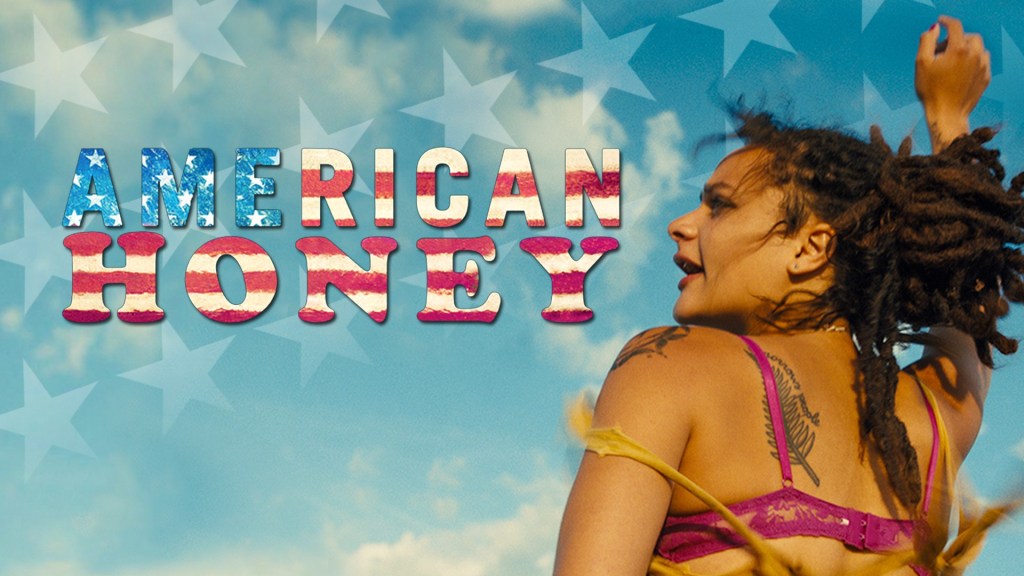
Just as filmmaking has evolved so too has the cinematic score. Music was once the only auditory cue for early films of the silent era. It has since gained the ability to greatly support a film. In films such as Forrest Gump (Zemeckis, 1994) and Guardians of the Galaxy (Gunn, 2014), their soundtracks lend to their overall success and popularity. An original take on this usage of popular music to connect the audience to a film is found from start to finish in American Honey (Arnold, 2016), a film about a group of young runaways who peddle magazines around the country. The film’s entirely diegetic soundtrack is just as important as its dialogue. The characters have the same access to each song that the audience is granted—an unusual occurrence for a feature-length film. Musical interactions between the runaways are provoked by these songs, and enduring scenes that shape the story are created. Music belongs to its listeners just as a movie belongs to the audience, and the audible and visual elements within American Honey coalesce into a meaningful narrative.
Sound and picture fuse and forge a unique relationship as we experience the soundtrack alongside the characters. Diegetic music is strategically yet naturally employed in a staggering number of scenes to narrate the characters’ journey on the road while deepening the audience’s emotional connection to them. Unlike picture, sound is limitless. In Chion’s Audio-Vision, he notes that “for sound there is neither frame nor preexisting container. We can pile up as many sounds on the soundtrack as we wish without reaching a limit.” Because a soundtrack lacks this container, there are infinite options in blending diegetic sound. The emphasized music enables character expression through vignettes, typically when the young outcasts come together before and after their respective daily hustles. Chion explores the different types of sound, from the obvious to the slightly nuanced exceptions. Chion states, “Acousmatic describes ‘sounds one hears without seeing their originating cause.’ Radio, phonograph, and telephone, all which transmit sounds without showing their emitter, are acousmatic media by definition.” In American Honey, the music is specifically “on-the-air sound” situated in the scene’s real time, making use of the freedom to transcend the restrictions of cinematic space. This on-the-air sound is also considered “screen music” which arises from a source located directly in the space and time of the film’s action. The audience shares the characters’ space inside the van in which they travel as a constant setting, often pushed forward by songs of varying tones and moods played through the vehicle’s speakers. Some of the characters surprise us with their song choice, which we are only informed of by their enthusiastic singing and lyrical knowledge.
Where Chion breaks down specifics and terminology surrounding cinematic sound, an article by Hoeckner entertains the more abstract and personal notion of music driving empathy. A study he conducted shows that music drastically alters the audience’s perception of characters presented before them. It comes to no surprise that thriller music increases skepticism and fear while melodramatic music tugs on heartstrings. Viewers use associative processing to construct a working narrative of the film based on its music. In Film Music Influences How Viewers Relate to Movie Characters, Hoeckner states, “This combination of a ‘cognitivist’ recognition and ‘emotivist’ arousal (Kivy, 1989) suggests a way of understanding how film music might contribute to viewers’ sense of empathy…the extent to which the observer understands and takes the target person’s perspective.” In cinema, music enhances the viewer-character relationship as it elevates aesthetic practices and engages a deeper psychological perspective.
In a pivotal scene that kicks off the third and final act of this film, lead runaway Star joins a truck driver for a few miles along his route in an attempt to sell him magazines. Much to her surprise, he is the first and only character approached in the film who expresses an interest in reading magazines in the modern, digital age. Briefly the audience is suspended in anticipation of Star’s universally bad and potentially dangerous situation with this stranger. In the opening of the scene, the truck driver turns his radio on, and a diegetic “Dream Baby Dream” by Bruce Springsteen begins to play. The opening chords of this on-the-air sound coincide with shots of the interior of the truck, which include a display of Christian crosses, family photographs, and the driver’s toy-sized Yorkshire Terrier panting from the back seat. When Springsteen’s vocals commence, Star lights up as she recognizes the song and sings along to the track with the driver. Passing through rural Midwestern suburbia, they share a tender moment in song, and Star learns he recently and proudly gave his daughter away at her wedding. The volume of the song remains consistent for the whole scene—prominent yet balanced while it shares space with the characters’ sporadic dialogue.
The crux of this scene comes to light when Star notices the stack of outdoor-enthusiast magazines on his dashboard, confirming his honest intentions as a customer while dismissing the potential for ulterior motives. Star shows him the variety of boating magazines in her catalog similar to those on the dash. Any anticipated tension breaks as he admits he’s never been to the ocean but dreams of going someday. In turn, he inquires what herdream is, a question she admits she’s never been asked before. The scene comes full circle as she ponders owning a big trailer with lots of trees and kids someday, and we witness her most sincere moment in all of the film. He unexpectedly agrees to buy subscriptions to two different magazines, and she is thrilled that he wants both. Because of Star’s refusal to lie and manipulate for a dollar, we witness her individual and absolute strength set apart from the rest of the gang. The scene ends as Star beams at her success in a new state of self-realization unified with the dreamy tune that still plays by the ultimate American working-class icon, Springsteen. Throughout American Honey, Star’s genuine approach leads to fewer customers but a higher volume of sales than the rest of the group who go door-to-door with fabricated stories hoping to elicit sympathy and effectively make sales. Without music, this scene would take longer to, if at all, relieve us of the anxiety we have over Star’s risky behavior to close a deal. This song in particular, which fills the entire scene, illustrates a deeper and more personal context for her. It tightly weaves her journey and provides a subliminal basis for the truck driver asking about her life’s dream.

To take this concept a bit further, an article by Holbrook explores “ambi-diegetic” music which like diegetic music appears on-screen, but like non-diegetic music serves to advance plot, characters or important themes. Scholars have long examined how diegetic music shapes cinema in terms of a film’s mise-en-scene, but only recently has the discussion of ambi-diegetic music come to the forefront. Because of the inherent relationship of sound and vision, music amplifies a scene in profound ways. Holbrook also describes ambi-diegetic music as it relates to
“a cinemusical moment…in which a character actually performs a tune or song within the image (i.e. produced on-screen) in a way that adds depth to that character by forming persona-related associations, elaborates on thematic aspects of the plot, or advances relevant symbolic identifications so as to enrich the meaning of the scene (i.e. dramatic development).”
Ambi-diegetic cinemusical moments work to contour the portrayal of not only our lead protagonist, Star, but of all of the runaways individually and collectively.
The advancement of popular music has coincided with the growth and experimentation of cinema, and in analyzing American Honey, it’s important to mention correlation and impact as it pertains to music videos. What was once predominantly a montage of the musician(s) performing against an ultralight or non-existent narrative has now progressed into an event of theatrical expression. Artists can subtly communicate messages or overtly make political statements. They can express a parallel narrative through visual storytelling that may only touch on the theme or tone of the song rather than align directly with its lyrical content. Many types of art, performance and storytelling, are commonly utilized in the music videos of today, and they have become an adaptable genre and medium for advanced narration. In an essay by Lapedis, she focuses on the evolving relationship of music as accompaniment to cinema and vice versa due to the growing potential created by music videos. Pop music and the three-minute song, she argues, has allowed the art of visual montage to take off. Using rhythmic editing, a sequence can be condensed to shorthand and accomplished in a more effective and powerful way when paired with song. Filmic moments that otherwise would risk a cliché can be creatively developed to drive narrative. Just as the music video’s changing status has allowed song and visual medium to become equal, the use of pop music instead of a score in cinema has raised the bar for a film’s soundtrack. This decision to use familiar songs over a traditional score taps into the audience’s broader understanding of pop culture and emotional conventions. Lapedis states that music in film is multi-functional, transformational, and anchors how the audience should interpret the visual components. The music video’s historical progression in both popularity and craft has increasingly inspired films with a non-traditional usage of music such as in American Honey. In this way, music functions in hypnotizing the audience into the story and the liminal space. Cultural associations attached to pop music make it a subtle yet effective immersion into a narrative.
In the second to final scene, music is utilized to display another side of the runaways, especially that of a character called QT. A masculine character, QT has only rapped and moshed along to the film’s musical moments until this point. The chords of “American Honey”, a country-pop song by Lady Antebellum, provoke QT to begin singing as the rest of the gang slowly follow suit, eventually breaking out into a singalong. Surprisingly most of the characters know the words, and it illuminates a new facet of the group who typically rotate between rap and hip-hop songs while traveling in the van. This moment coincides with Star’s emotional reeling after her rejection from her love interest and leader of the gang, Jake. Her eyes swell with tears, and she non-verbally leans into QT who serenades her with the ending of the song.
In Bordwell’s “Classical Narration”, one of the three spectra that narration is categorized by is its ability to be self-conscious. The filmmaker’s decision to conclude with a song that shares the title of the film is a bold choice and certainly one that is reflexively self-aware. This is not the first reference to the film’s title, but it is the least subtle. The other two spectra of narration, knowledge and communication, are toggled back and forth throughout the film, especially when music comes to the forefront. Our narrator Star receives the majority of her knowledge of the supporting characters through the music they enjoy. Their enthusiasm and informal performances of what they play on the radio communicates their similarities as well as their worthiness of trust. Because the audience meets, travels, and bonds with the crew alongside Star, their selection of songs and how they resonate to this music is key to our understanding of the story, and the harmoniously narrative American Honey delivers a successfully modern tale of life on the fringes.
Works Cited
Benski, T. (Producer), & Arnold, A. (Director). (2016). American Honey [Motion Picture]. USA: A24.
Bordwell, D., Staiger, J., & Thompson, K. (1986). The Classical Hollywood Cinema: Film Style & Mode of Production to 1960. Poetics Today, 7(1), 179.doi:10.2307/1772109
Hoeckner, B., Wyatt, E. W., Decety, J., & Nusbaum, H. (2011). Film music influences how viewers relate to movie characters. Psychology of Aesthetics, Creativity, and the Arts, 5(2), 146-153. doi:10.1037/a0021544
Holbrook, M. B. (2004). Ambi-Diegetic Music in Films as a Product Design and Placement Strategy: The Sweet Smell of Success. Marketing Theory, 4(3), 171-185. doi:10.1177/1470593104045535
Lapedis, H. (1999). Popping the question: The function and effect of popular music in cinema. Popular Music, 18(03), 367. doi:10.1017/s0261143000008928
Prince, S. (1995). Audio-Vision: Sound on Screen . Michel Chion. Film Quarterly, 48(4), 40-42. doi:10.1525/fq.1995.48.4.04a00070
 Cayce "Birdie" Tiedemann
Leave a comment